Coast & beaches Family-friendly Walking
The top of Ireland
Inishowen is the big, wild peninsula at the very top of Ireland, wedged between Lough Swilly and Lough Foyle, and its tip at Malin Head is the most northerly point of the mainland. It’s a place of empty beaches, mountain passes, ancient forts and huge skies, and on a clear winter night, with a bit of luck, you might even see the Northern Lights.
It’s a long drive from most of the country, at around three and three-quarter hours from Dublin, so make it a long weekend. The roads are quiet, the welcome is warm, and the scenery is some of the best on the Wild Atlantic Way.
Driving the Inishowen 100
The Inishowen 100 is a signposted scenic loop of about 100 miles (160 km) around the peninsula. You can drive it in a day, but it’s much better over two, with plenty of stops. Start in Buncrana and head north, or start in Moville and go the other way. Either way, these are the highlights.
Malin Head and Banba’s Crown
At Banba’s Crown, the northernmost tip, a signal tower built in 1805 stands above the cliffs, with old wartime lookouts and the word ÉIRE spelled out in stones, a navigation marker for aircraft from the Second World War. Follow the cliff path to Hell’s Hole, a deep chasm where the sea roars in, and look out for seabirds, seals and, sometimes, basking sharks and dolphins. Malin Head was also a filming location for Star Wars: The Last Jedi.
Just south, Five Finger Strand is one of the most beautiful beaches in Donegal, backed by some of the highest sand dunes in Europe. It’s not safe for swimming, but it’s glorious for a walk.
Mamore Gap, Dunree and the west coast
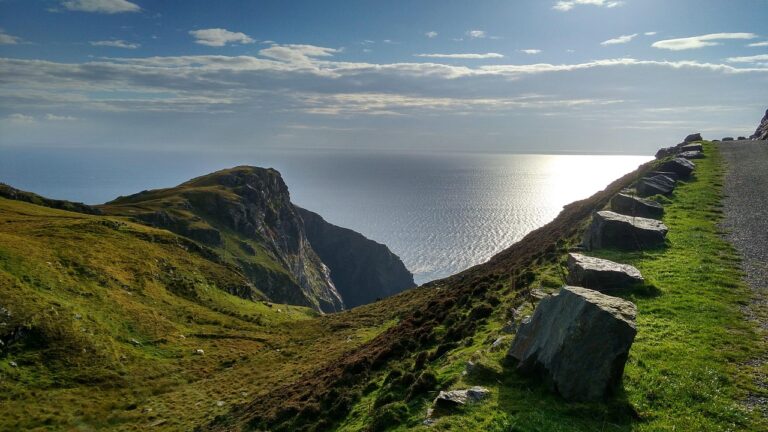
On the Swilly side, the road over the Gap of Mamore climbs steeply between two mountains, with views over the Atlantic and Lough Swilly that will stop you in your tracks. Below it, Fort Dunree is a coastal fort on a rocky headland with a military museum and cliff walks. Nearby, Glenevin Waterfall near Clonmany is reached by an easy woodland path, ideal for families.
- Doagh Famine Village: an outdoor museum telling the story of life on the peninsula from the Famine to the present day.
- Ballyliffin: a seaside village with two famous links golf courses and the long Pollan Bay beach.
- Kinnagoe Bay: a sheltered cove where a ship of the Spanish Armada, La Trinidad Valencera, sank in 1588.
- Greencastle: a fishing port with a maritime museum and fresh fish straight off the boats.
Grianán of Aileach
On a hilltop near Burt, at the southern edge of the peninsula, the Grianán of Aileach is a huge circular stone fort, probably built in the early medieval period on a much older site, with views over Lough Swilly, Lough Foyle and three counties. It’s free, open at all times and one of the most atmospheric places in the north-west. Go at sunset if you can.
The Northern Lights
Inishowen’s northerly position and lack of light pollution make it one of the best places in Ireland to see the aurora borealis. Your best chance is on clear, moonless nights from autumn to spring, when solar activity is high. Sign up for aurora alerts, head to a north-facing spot like Malin Head or Five Finger Strand, and be patient. It’s never guaranteed, but the stars alone are worth the trip.
When it rains
Try Fort Dunree’s museum, the Doagh Famine Village, the Greencastle maritime museum or a long lunch in Buncrana. Derry, about 30 minutes from Buncrana, has the city walls, museums and plenty of indoor options.
Which area to stay in
Buncrana is the biggest town, with shops, restaurants and the shore walk. Ballyliffin and Malin put you closer to the wild north coast, and Moville and Greencastle suit the Lough Foyle side. Self-catering cottages are plentiful.
A three-night plan
Friday: drive up via Derry and check in in Buncrana or Ballyliffin.
Saturday: Fort Dunree and the Gap of Mamore, Glenevin Waterfall and Five Finger Strand, with a stargazing walk if the sky’s clear.
Sunday: Malin Head and Hell’s Hole in the morning, then Kinnagoe Bay and Greencastle.
Monday: the Grianán of Aileach on the way home.
Inishowen is perfect for the June and August bank holidays, and the autumn and winter long weekends for the best chance of the aurora. Combine it with the Causeway Coast via the Lough Foyle ferry, or see more of Donegal.
Frequently asked questions
Can you see the Northern Lights from Malin Head?
Sometimes. Malin Head is one of the best spots in Ireland, but you need a clear, dark night and strong solar activity. Autumn to spring gives you the best chance.
How long does it take to drive the Inishowen 100?
You can drive the 160 km loop in a day, but allow two days to stop at the beaches, forts and viewpoints without rushing.
Do the Inishowen ferries run all year?
No. The Lough Foyle ferry from Greencastle to Magilligan and the Lough Swilly ferry from Buncrana to Rathmullan run mainly in summer. Check with the operators before you plan around them.
Do I need sterling on the way to Inishowen?
Inishowen is in the Republic, so it’s euro. The quickest route from Dublin passes through Northern Ireland, so a little sterling is handy for stops on the way.
Where we’d stay
A comfortable hotel and spa overlooking Pollan Bay in Ballyliffin.
A seafront hotel in Buncrana with a leisure centre, beside the shore walk.
A friendly village hotel on the green in Malin, close to Malin Head.
We may earn a small commission if you book, at no extra cost to you.
Getting there
A long drive from the south, so make it a three-night weekend.
- By car: about three and three-quarter hours from Dublin via the M1 and A5 through Northern Ireland and Derry, or about an hour and a half from Donegal town.
- By bus: coaches run from Dublin to Derry, with local buses on to Buncrana, Moville and Carndonagh. You’ll want a car for the peninsula.
- By ferry: in summer, the Lough Foyle ferry links Greencastle with Magilligan for the Causeway Coast, and the Swilly ferry links Buncrana with Rathmullan.
Timetables change, especially on bank holidays, so check with the operator before you travel.